 When I was growing up in Elmwood in the 1940s and 50s, the first week of September was a special time. I argued with my parents that the school board should call off classes so kids could spend as much time as possible on the kiddie cars or merry-go-round. Besides, who wanted to diagram more sentences or fill in more workbooks? In the late 40s, I felt kids needed more time on the Ferris wheel or to work on our soap box derby racers which we ran down “hospital hill.”
When my class was over, I’d head to Central Park to watch the grease-smudged carnival workers putting the Ferris wheel together, piece by piece. I was always amazed about how easy it was for workers to erect a large tent for the American Legion Bingo games. Members of the Congregational, Presbyterian, and Methodist churches served meals from lunch through dinner or when they ran out of food in their tents. On Saturday night, the last day of the festival, adults would hang around until at least 11 pm when one lucky kid pulled out the winning ticket for a new Nash Rambler or a Kaiser-Fraser automobile. Throughout the 40s and 50s the Elmwood American Legionnaires used the car raffle to buy new swings in West Park or to replace the plates in the diamond at Sweet Water Park.
——————–
Last week as I walked about Central Park I began to wonder when the Fall Festival began and who started it. Thank goodness for microfilms of the Gazette. A group of businessmen met in the Elmwood city council chambers in August 1890. Fred Jay, a local grocer and president of the school board, was named chairman. This “ball of fire” had stepped forward to head several community projects over the years so he was a good choice. After much discussion, Jay rose and spoke confidently, “I’ve heard enough. I’m going public.”
Let me paint a picture of what the town would have been like over 125 years ago: a population of about 2,000, dirt roads, no electricity, cisterns, outdoor toilets and no cars. Leisure activities were limited.
Three weeks after the first meeting, a second was held in Liberty Hall to organize. A number of farmers strongly supported the idea and said if “Elmwood fails to organize a fair association, all responsibility will be attached to the town.” A successful farmer in Trivoli Township said “Elmwood cannot afford to let this opportunity pass.” He was ready to invest $100 for four shares of stock.
The editor of the newspaper admitted that some naysayers were concerned that the fair would lose money, but he was a strong proponent. “This is a matter that will benefit us all alike…Elmwood must and will have a fair.”
During most of 1891, the newspaper promoted the inaugural fair, running Tuesday through Friday evening during the first full week of September 1891. According to the Gazette, “The first Annual Fair closed Friday evening. The crowd during the week was large – 5,000 being present Thursday. The exhibit was fine, the weather could not have been better, the racing was exciting, the premiums will be paid in full and all went away satisfied. The total receipts amounted to $2,000, enough to pay all the expenses and pay off indebtedness of $700.” This is the first mention that horse racing was the main attraction. The editor the next week said, “The racing was more satisfactory than any had ever seen at a local fair in this region.”
The description of the second annual fair clearly indicates that it was more than merely a horse race, including many exhibits of home grown or home made products like jellies, preserves, bread and cakes than a year earlier. Even the merchants began to showcase their goods: Charles Potts displayed his latest four-button suits, Edson Smith showed off the latest coal-burning cook stove, and Fred Jay promoted canned tomatoes from the local canning factory. The second year was more like a county fair.
The third fair, held in 1893, advertised cash premiums, and the Association was granted privileges to operate games of chance, the first reference to gambling.
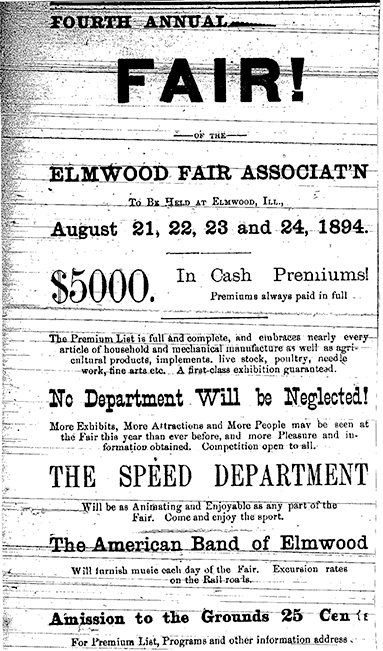
During the fourth year of operation (1894) the cash premiums climbed from $3000 to $5000 and the price of admission from 25 to 35 cents per person. At the same time, the number of days of operation mushroomed. The grounds were used almost every week of the year when the weather was suitable. In addition, many of Elmwood’s acclaimed Fourth of July activities were moved from Central Park to the Grounds so horse racing became a big part of the festivities.
As the years went by, the Fair Grounds provided a venue for high school athletic competition for the area as well as a place where traveling circuses could perform. A well-known horseman, Mark Field, attended a fair and remarked, “While Peoria was tussling with Springfield for the State Fair, the sprightly town of Elmwood was industriously working up its own fair and so closely attended to its knitting that it has this year risen to the dignity of the Peoria county fair town.” (Elmwood Gazette, Sept. 20, 1894.)
Trouble surfaced in the March 28, 1901 issue of the paper: “It is whispered that the Elmwood fair this year will be run without any bar or gambling games of any kind – that even the pool sellers will be barred and the cigar spindle man will be cast into the outer darkness.”
By October 15, 1903, the newspaper covered an important meeting of the Elmwood Fair Association, reporting the fair will be discontinued and the land and buildings will be sold to the highest bidder.
Raymond Troth, an old timer, (1883-1960) remembered the downfall of the Elmwood Fair in his memoirs written in 1959. “The Elmwood Fair is an event of the past. It was very nice in its day and well patronized by the public and the community. The exhibits were excellent. Good harness racing was one of the major attractions…It was here I heard my first transcribed playing record. One had to listen through ear phones. I thought it was wonderful. The saloon finally got a foothold on the grounds, then gambling. Temperance people boycotted such doings and the fair fizzled out.”
Each day, when you drive north out of town, remember the appropriateness of the sign which reads “Fairground Acres,” probably the birth place of the Elmwood Fall Festival.
October 2018
 Stories From Small Town Illinois
In the late 1940’s it was so much fun to go to the Fall Festival. You could win a paper fan or small bamboo cane at the Pick-up Ducks booth. The Fair Store invited students to paint Fall scenes on their store windows. We used pink window cleaner colored with food coloring as our paint. Nice memories of slower times. Thanks Karl for bringing back those events from our past.
LikeLike
Wonderful look back on small town America history.
LikeLike
Karl: I always enjoy your writings of the early days in Elmwood, too many small towns have no one to help others remember what it was like in those early days. You do such a great job of bringing it all to life, thank you.
LikeLike
Your memories combined with the history you share is truly unique. Elmwood is fortunate to have your writing that so wonderfully revisits so many memorable happenings there.
LikeLike
Karl K Taylor. Thank you for history lesson. I always enjoy learning about my home town. My brother, Jim, won the Elmwood soap box derby one year. Went on to win the Peoria derby. Then was defeated by the eventual winner of derby in Akron Ohia. I think i have correct as i was very young when this took place. I think Jim was 10 and i would have been 5.
LikeLike