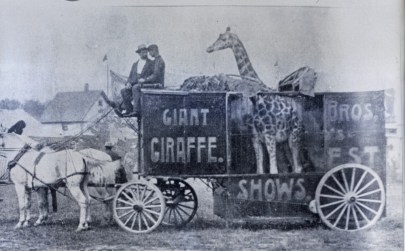
 In 1889 the schedule for the Ringing Brothers and Van Amburgh’s Combined Circus and Menagerie was confined to Wisconsin and Illinois, moving from north to south, south to north. Leaving their headquarters in Baraboo, Wisconsin, on May 4, they performed in little towns 10 to 20 miles apart returning to end their season in Lodi, Wisconsin, October 15.
While crisscrossing the two states primarily in horse-drawn wagons (circus trains came a year later), the circus performed in 140 towns, which involved putting on 140 grand parades and 280 shows under the Big Top. That year, management tried an experiment: could they perform in a different community every day of the week, except Sunday, without falling behind the schedule or losing money?
_________
The story begins in Central Illinois, first in Princeville on July 5 and one day later in Elmwood. Since both towns had almost identical populations (2,000), one would expect that the circus would attract a similar number of patrons from each town, but it didn’t. In Princeville the box office sold $200 worth of tickets from the afternoon show and $138.75 from the evening performance – quarters from children and half dollars from adults. Ringling Brothers had a profit of $207.90.
As the Princeville patrons headed back to their homes after the evening show was over, the circus staff of over 200 full- and part-time workers dismantled the Big Top about the size of a full-sized basketball court, took down the bleachers and folding chairs and began feeding and watering the animals: 110 horses and ponies, 1 giraffe, 3 elephants, 2 leopards, 1 American panther, 3 lions, 1 kangaroo, 1 hyena, a stork, and cages of both monkeys and birds. Without a public water system at that time, the workers relied on dug wells or creeks, a task that must have been overwhelming. The staff was in a big hurry that evening because it would take over two hours on dirt roads to reach Elmwood where they would perform the next day.
They had an enormous amount of work to finish before they would be ready for the next performance. Once done, the staff found spots in a wagon where they could sleep. When they reached Elmwood, they had to raise the Big Top in the dark, assemble several smaller tents where the performers would eat their meals (their hot breakfast was served at 6:30) and dress for the parade at 10 a.m. (Before World War I, the U. S. Army spent considerable time studying circus logistics, and adapted many of their methods while fighting the Axis powers in Europe. The key to the circus’ success was standardization.)
On July 6 in Elmwood (or any typical day the circus was open) the day started at 10 a.m. with a free parade that began at the Hurff farm north of town (the current site of Maple Lane Country Club) and travelled south down Magnolia Street for a mile on a dirt road to Central Park. Along the parade route little children sat on the grass beside the dirt road and were mesmerized by an elephant. In the business district where the merchants were busy, Fred Jay, the grocer, was peddling his wares, Potts’ Haberdashery was featuring a sale on Sunday- go- to- church straw hats, and the livery stable was full of horses ridden from Yates City, Oak Hill, Maquon, or Gilson. As the circus procession reached Central Park, the band climbed the steps to the ornate Victorian bandstand where the musicians broke into Yankee Doodle and the Battle of Hymn of the Republic followed by other pieces appropriate for the day. For a time, the jugglers and clowns with their monkeys circled the bandstand while youngsters and their parents were drawn to the cages of wild animals – the lions and tigers and the giraffe, animals that few, either adults or children, had ever seen before.
If the parade was a success, the little ones and their parents were awestruck by what they saw, the amazement continuing into the Big Top at 2 or 7 p.m. Before each show began, patrons could listen to a band concert or tour the menagerie, all included in the price of admission. The Ringmaster introduced the opening act, welcoming children of all ages to the first event – a colorful parade of animals, jugglers, and clowns. For two hours awestruck visitors watched aerialists swinging from one high wire to another, bareback riders galloping their horses around the rings at break neck speed, and silly clowns teasing members of the audience. The program ended with a rowdy version of the national anthem.
As the crowds were leaving the show, the Ringling management was checking the books: $806 in ticket sales, $227 in expenses, and $679 in profit. Meanwhile the grounds crew had started taking down the Big Top and loading their wagons for a leisurely ride to Canton where they would rest for one day (a Sunday) and perform on July 8.
On that one Saturday in 1889, people streamed into Elmwood from the countryside, eager to be awed. None left disappointed. The show was “acknowledged by all as superior to any one of its kind now traveling. This was magic. The viewers were separated from the performers, not only by the ring, but also by that indefinable barrier that divides the ordinary from the extraordinary….” “The circus has come and gone,” the Elmwood Gazette said. ”This circus will not be the last to visit our fair city, but it was our first… The press and the public have “pronounced that this is the largest and best circus and menagerie they have ever seen.”
Before Ringling Brothers went on to amaze the nation, they first amazed two small towns in Central Illinois. They came and went, but we remembered.
___________
The author is indebted for background material on the Ringling Brothers Circus at the special collections and rare book room at Milner Library, Illinois State University, Normal, Ill. and the photo of a giraffe in a cage from the collection of Ivan Henry from http://www.thecircusblog.com.
In writing this piece, the author would like to acknowledge the assistance of Arissa Huffcutt, the 2017 valedictorian of Elmwood High School in Elmwood, Illinois, currently completing her freshman year at Brigham Young University, studying neuroscience.
 Stories From Small Town Illinois
Always enjoy your stories about Elmwood and the surrounding area, keep up the good writing!
LikeLike
Your stories are all so interesting. Keep up your wonderful work!!!
LikeLike
What a wonderful bit of history! Thank you so much for sharing.
LikeLike
I always enjoy a good circus story. Thanks for sharing.
LikeLike
Very good Karl enjoyed this story very much. Keep writing.
LikeLike