 Since he played the clarinet in the American Band, Nelson Dean Jay, seventeen years old, took his place to the right of the conductor, sitting on a wooden folding chair beside Frank Shively, a skilled carpenter on his right, and Earl Runyon, a butcher on his left. Joking with his friends, Jay placed the music on his stand and opened his instrument case.
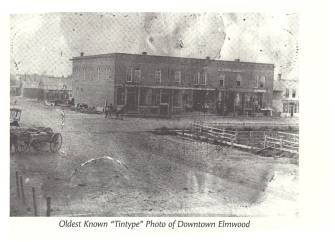
The musicians were located in Central Park on the second floor of the bandstand, covered with gingerbread, and shaded by tall elms for which the town was named. The park was surrounded by various merchants: Ellis Brothers’ Hardware and Tinware; the Palace Meat Market; Snyder’s Livery and Feed Stable; Turner’s Boot and Shoe Store; and Clinch, Schenck & Lott, Bankers.
The twenty-odd musicians were all dressed in black band uniforms and black hats; some teenagers, others gray-haired townspeople, who practiced twice a week in the city council chambers above the Neptune Fire Department. Practicing took a lot of time, but the members enjoyed performing for their friends and neighbors on special occasions or being invited to play in surrounding towns like Brimfield or Canton.
Central Park was filled with hundreds of people, waiting for the concert to begin.
————–
Elmwood was a community of 2,000 situated in the central part of the state, twenty miles west of Peoria, a river town with more than 50,000 and twenty miles east of Galesburg, the railroad town with about 10,000. It was an area served by dirt roads. Local farmers raised hogs, cattle, corn, beans, and hay, and pulled wooden farm implements with teams of horses. Families lived hard lives, mostly worked with little pleasure. Unlike other small towns in the area, Elmwood wasn’t merely a farming community because it also had a coal mine, paper mill, canning factory, and other small businesses employing several hundred people. It had more than sixty retail merchants.
Most everyone was thrifty, saving their money, hoarding used paper grocery sacks and rolls of twine, and growing big vegetable gardens. Jay’s father once raised five acres of potatoes. Vacations were unheard of except for visiting relatives. No one had an automobile. In an 1899 newspaper, the sighting of an automobile that week in town made the news. At the turn of the century, the Jay family took occasional trips to see their relatives in Oklahoma and Kansas by train, but only once for a genuine vacation. A group of couples from town, including Jay’s parents, took a trip to Niagara Falls. Many folks lived within this 50-75 mile area all their lives without traveling even as much or as far away as the Jays. No one went to Florida in the winter or to Europe at the end of a successful career.
Although he had electricity in his home as early as 1890, the family didn’t yet have all the modern conveniences, and still had to rely on an outhouse behind their home. If they actually knew anyone who had a telephone to call, young Jay had to trudge five blocks to Quigley’s Drug Store to stand in line to use the only public phone in town. The high points of Jay’s life were Presbyterian Sunday School picnics in a cattle pasture along the Kickapoo Creek or taking bumpy train rides to Galesburg to shop at “The Big Department Store: O.T. Johnsons.”
————–
As Jay waited for H.M. Kilpatrick, the full-time undertaker part time-conductor to raise his baton, the boy stared out at the large audience. Besides those seated on the park benches, dozens of couples strolled, hand in hand, on the wooden sidewalk – the men in white shirts, suspenders and straw hats, the women wearing long frilly dresses, large fluffy silk hats, and twirling light-colored parasols. Buggies circled Central Park, the riders going round and round, trying to catch a breeze or two, while listening to the American Band, a local favorite for more than 50 years.
The buzz of the crowd became silent when the conductor began with a rousing version of Sousa’s “Manhattan Beach.” The audience showed their obvious pleasure, tapping their feet and humming the melody. Peering out of the bandstand, Jay could see his grandmother, a widow, sitting beside his two sisters – Margretta, now fifteen, and Frances, his favorite, who was nine years old.
His grandfather, Nelson Dean Jay, had died five years before, having been first a Methodist and next a Presbyterian preacher, later a real estate developer, and finally a Democratic politician, twice representing Peoria County in the Illinois legislature. With her influential husband’s passing, Grandma Jay spent her time working in the church and taking care of her grandchildren.
As the applause for the Sousa number came to an end, Jay could hear a train just two blocks away on the C. B. & Q. tracks, heading west first for Yates City and later for Galesburg. Jay glanced at his watch. The engineer had better hurry.
The conductor whispered a few words to a horn player and turned the pages to “My Old Kentucky Home.” Since Elmwood was founded by New Englanders, the song was not a particular favorite with the audience, whose parents and grandparents had been members of the Underground Railroad. When the conductor raised his baton, the band began to play once again.
————–
Across the street, Jay could see his Dad standing in front of his grocery store, wearing a white apron and a bow tie, his name emblazoned between the first and second floors of his store: “Fred D. Jay.” Nothing indicated that he sold groceries and some dry goods as well as served as the postmaster, when the Democrats were in control, and sold insurance when the Republicans were in the White House. Dean liked to work in the store, picking up mail from the trains at the depot, sweeping the floor or even stocking shelves. He loved to be around people.
Nelson Dean Jay Sr., who had only a few years of formal education, must have been very proud of his three boys; how many fathers could brag in 1900 that two of his three children had graduated from college? Fred, although he never went to college like his brothers, was a successful grocer who settled in Elmwood, one brother became a physician and the other an educator. Jay’s father, Fred, married Elizabeth “Lizzy” Buchanan who came to Illinois from Pennsylvania. She was a distant relative of the former President, and before her marriage she taught in a one- room country school.
Like most women of her day, Elizabeth Jay stood in the shadows of her husband and his career, but she was active in women’s activities in town. She was a member of the Elmwood Philosophical Society which met periodically to hear talks on “The American Poets” and “The English Language.” She sometimes entered flowers from her garden in competition at the Elmwood Fair and served as president of the Cemetery Improvement Society. She was recording secretary of the Elmwood Women’s Club which planted flowers in the parks and raised money for playground equipment. Soon after Fred and Liz were married, they built a modest home in 1888 on Magnolia Street, probably the nicest area in town, just a few blocks north of the business district. The houses on Magnolia came in irregular sizes, some quite large, others rather modest. The Jay property was modest, located between two larger homes. So the Jays were not wealthy, but lived in the same neighborhood, surrounded by leaders of the community.
Fred Jay was not only a successful businessman, but a mover and a shaker in town, belonging to many organizations and serving as an officer in several. A visitor called Fred “clever” for placing the post office in his grocery store, attracting people who wanted to buy stamps or mail letters, but who otherwise might not go to his store. Fred served on the local school board for eight years, worked on several committees in his church and participated in the Odd Fellow and Masonic lodges. He was a community promoter who often served as master of ceremonies at such activities as alumni banquets or Fourth of July celebrations.
Fred knew the value of supporting local businesses which provided jobs to his customers. When a local paper mill burned down, he signed a petition to encourage its return. Fred loved the American Band, and along with others, contributed money to keep the concerts going and to bring vaudeville acts to Elmwood. When money was needed to open another seam of coal at the Elmwood mine, Fred raised funds to help the mine operator. When the city installed its first fifteen street lights at a total cost of $500, he put his share in the hat, saying “The town couldn’t afford to grope about in the dark much longer.”
————–
After the band began playing Mackie’s “Cracker Jack,” Jay, the seventeen year old high school senior, was daydreaming about what he might do for the rest of the day. He might watch the greased pig contest later that afternoon, but he couldn’t imagine what he would do with a pig if he caught it. When the temperature dropped, he hoped to ride in the three-mile bicycle race where the first prize was “Three dollars’ worth of goods from any store in Elmwood.” He could use the $3 for a new straw hat that he had seen in the window of Charles, Potts and Company, the haberdashers. He loved clothes. Unknown to him, years later, he would enjoy traveling each year to London where his tailor showed him the latest fashions in men’s clothing.
After eating fried chicken, mashed potatoes, green beans and apple pie at the “Congo” (Congregational) Church, all for 25 cents, that evening he’d probably go see “Edison’s Kinetoscope and Concert Company.” As it was described on the poster: “Showing Edison’s very latest and up-to-date attractions. Canvas will be stretched in the Public Square where all can see Admiral Deweys [sic] Grand Reception in New York, the Heroic Charge of San Juan Hill; Spanish Bull Fight, and a score of other attractions including the JEFFRIES -SHARKEY FIGHT in full life motion.” They all sounded exciting, far from his experiences in a small town in central Illinois.
After seeing that silent show, he might daydream about the rest of his life. Would he ever see a bull fight in Spain? Would he ever go to Coney Island? What career would help him reach his dreams?
There were many reasons why Jay’s future might be bright. No one knew how bright, but he had good role models: a popular, well-respected grandfather and two successful uncles, one a physician and the other an educator. Jay’s father may not have been a college graduate, but he was a popular merchant who exposed his son to hard work and to the importance of being involved in the community. Jay had learned much just by watching his father.
As for the immediate future, Jay was debating between becoming a haberdasher, because he liked clothes, or going to college, because his family had greater aspirations for him. He had one year to decide.
— Karl K. Taylor, Copyright 2012
 Stories From Small Town Illinois
Karl, you have written another gem! Thanks for sharing! You make your subjects and their surroundings come to life! I felt as if I were part of the scene!
Kathy
LikeLike
Love this!!! Very interesting! I love to read about this history in the area! Thank you!
LikeLike