

This essay was originally published in the program for the 2009 Historical Society Annual Dinner in Washington, Illinois. Part one was written by Christy L. Parr and it included the following paragraph:
“President Kathy Bandeko was focused on the restoration of a disintegrating round barn located on farmland at the southeast edge of Washington. Her brother, a professor of architecture at the University of Illinois, was interested in the restoration as a project for his classes. Ultimately, the project proved unfeasible for numerous reasons – the barn had to be dismantled and moved, no affordable rebuilding site could be found, no practical use for the barn was identified, no monies were available to fund the project and our membership was definitely no match for the physical labor requires.”
Part Two – by Karl K. Taylor
In the early 1990s, the descendants of Dr. Harley Zinser were interested in selling the doctor’s home and office, the home built in 1858, and the office built in 1916. With this information, Don Gronewold, the mayor of the City at the time, approached Marguerite Lucas, who was then the president of the Washington Historical Society, about the organizations buying the two buildings. He argued the organization needed a permanent home, that they could enhance the appearance of that part of the city, and that this facility would help develop a sense of the importance of history in Washington.
During the process, Leslie Kenyon, an architect and specialist in preservation and restoration of historic structures, pointed out that there were very few homes of the 1858 vintage remaining in central Illinois. Located one block from the town’s historic square, the Zinser home is one of the oldest buildings in the community as well as the county. Timbers were hand hewn; bricks were molded and fired at the site. Originally, the home had only six rooms – two bedrooms upstairs – and four on the main floor, but two more were added.
Since the Society had no money or assets, the City offered to purchase the two properties from the estate of Caroline Zinser Martini, the doctor’s daughter. For $73,917. Until the buildings were paid off, the City initially charged the Society 6% interest on the ten-year loan, but the interest increased over time to 10% by the tenth year. The reasoning was to help the Society but to encourage them to pay off the loan as quickly as possible. To make the agreement more enticing, the City agreed to return the interest if the Society placed it in an endowment to maintain the property.
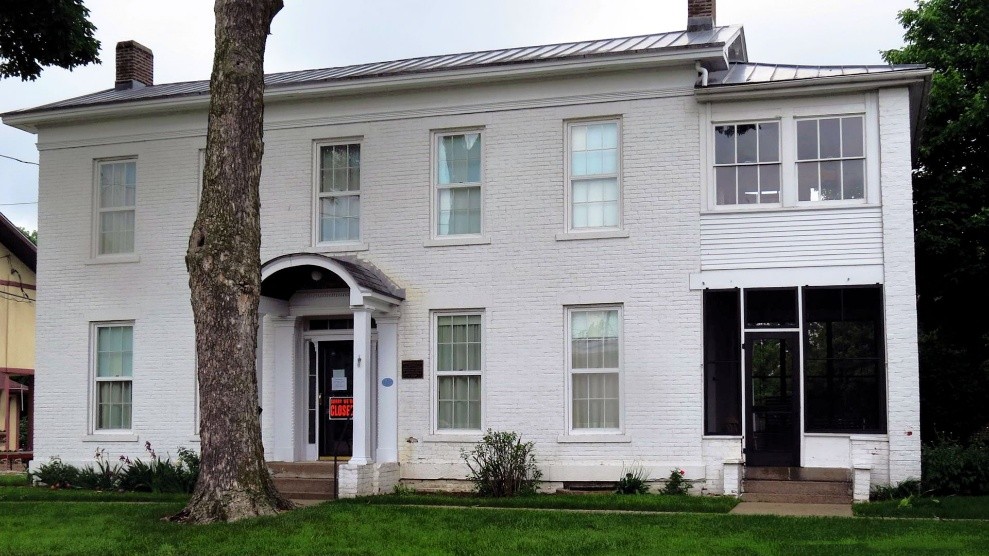
With great trepidation, little Marguerite (little in stature only) brought the idea to the Board, who agreed on October 17, 1994, to support the plan. Everyone was nervous. Committees were formed on October 24, 1994, to estimate costs, begin restoration plans for both the exterior and the interior, create a publicity plan and develop fund-raising strategies. It was estimated that it would take approximately $600,000 for the entire project: $100,000 (including interest) to purchase the properties, $100,000 to restore them to the 1920s era, and $400,000 to establish an endowment to maintain the properties. Except for campaigns for church buildings, this campaign was, at this time, one of the largest ever conducted in Washington.
Many people said, “It can’t be done.” The fund-raising committee was undeterred. They decided to concentrate on raising $200,000 for the purchase and renovation of the properties and see bequests over time to fund the endowment.
Two important committees were named and began work immediately. The steering committee included Walter Ruppman, Herman Essig, Dale Claus (the city manager), Bob Summer, Gilbert Gross, Marijane Baer, Helen Lytle, John Bearce, James McDaniel, Donald Dempsey, Mary Habecker, Joan Ruppman, Karl K. Taylor, Gary Uftring and Francis Whittaker. The fund-raising committee consisted of Karl K. Taylor, Donald Uphoff, Walter Ruppman, Lois Sampson, Bert Nordhielm, Joyce Nordhielm, Dr. Paul Kinsinger, Gilbert Gross, Max Bass, Jeanne Essig Lersch, Louis Heimann and Jean Keely. The committees met often, some monthly, some weekly and in some instances, for several years.
Two more important committees were formed to plan for the restoration of both the interior and the exterior of the two properties. Our records are a bit sketchy, but we believe that these members worked on the interior committee: Helen Lytle, Joyce Nordhielm, Joanne Summer and Patrice Essig. The exterior committee consisted of Herman Essig, Bob Summer, Roger Sauders, Bert Nordhielm and Dick Scott. These people picked out paint and wallpaper, secured antiques and hired painters, plumbers and roofers. We are certain others were involved, and we will add their names as we dig through the records.
Early in the process, as the plans were drawn and estimates of costs were determined, the Society did a number of things to bring the project to the public’s attention. Several members wrote articles which appeared in the local newspapers and in the Peoria Journal Star. During October 1995, a special event was held so potential donors could see the house in disrepair and learn about the organization’s plans. They parked at St. Mark’s Lutheran Church and were driven to the Zinser house in antique cars, listened to descriptions of the projects and were served homemade pie and ice cream outside on the lawn between the two properties. When finished, they were once again driven in antique cars back to St. Mark’s. As the properties were in the process of restoration, they were featured on local PBS station, Channel 47’s “Illinois Adventures,” hosted by Jim Wilhelm.
To raise money, members of the fund-raising committee sent letters to prospects as well as made individual contact with them. The funds started coming in. A special proposal was made to the Caterpillar Foundation, who supported our efforts with a grant of $25,000. During the process of raising money, it was decided to sell commemorative bricks which now form the sidewalk in front of the two buildings.
From that effort alone, $60,000 was raised. To this day, people are still buying bricks. Hearing about the work of restoring the properties, a former native of Washington, who now lives in Oklahoma, Peter Childs, offered to contribute $15,000 to the campaign if the Society would match it with an identical amount from other donors. That effort was also successful, beating the three-year deadline in a little more than one year. A special campaign, called the “Minutemen of Washington;” was launched and aimed at donors who pledged $500 annually for five years to finish paying off the mortgage.
The work of hundreds of volunteers paid off. While many people said, “it can’t be done” in late 1994, some were surprised in 2002 to learn that “it could be done. And it was done.” The Washington Historical Society was able to buy, pay for and renovate an old house and office, and create an endowment for their maintenance, thanks to hundreds of donors, who provided their dollars, time, skills to bring the effort to a successful conclusion. The final achievement came when the properties were placed on the National Register of Historic Places in December of 2002.
After the funds were finally raised to complete the renovation and to pay the mortgage, the Society began doing a number of things to generate additional funds, to increase awareness of the organizations and to emphasize the importance of history of Washington. From time to time the Society has conducted garden walks, featuring beautiful flower gardens in the community. Several years ago, the Society held a Heritage Day, including an antique appraisal and auction. For a number of years, they published a monthly newsletter, with articles about the city and the Society has sponsored a cemetery walk each fall, highlighting the families of prominent Washingtonians who are buried in the Glendale Cemetery. In 2009, the Society is focusing on Civil War soldiers who are buried there. Each year, six or more homes have been open at Christmas time for tours, again sponsored by the Society. Several years ago, a new program was established, called “Time Travels in Trunks,” providing historical presentations in the elementary schools of the community and supported by grants from the State of Illinois as well as private foundations. During 2008 and 2009, the Society was responsible for the presentation of several plays on Abraham Lincoln, in connection with the high school drama department and the Abraham Lincoln Bicentennial Commission. Finally, with new facilities, the Society has begun to provide genealogical research for families interested in their ties to historic Washington. This work has been provided by an untiring archivist, Carol Dorward.
The Washington Historical Society began in 1980 with a handful of volunteers who met monthly in church basements and who failed at their first important effort – restoring an old round dairy barn. That failure has been followed by a string of success. Today, the Society can rightly take great pride in its accomplishments over the last twenty-eight years. With its solid knowledge of and appreciation for the past, the Society, with your help, is prepared to meet the future with great confidence.
 Stories From Small Town Illinois